

The Last Mile of Accreditation: Closing the Gap Between Quality Assurance and Patient Awareness
By Global Healthcare Accreditation
Accreditation can transform how a healthcare organization works. But can it influence a patient’s choice if the patient never sees it? Healthcare organizations invest heavily in standards, safeguards, governance, and continuous improvement, yet the resulting quality signal may never reach the people it is intended to reassure. Findings from GHA’s IMPACT™ Study suggest that this “last mile” cannot be taken for granted.
The Accreditation Paradox
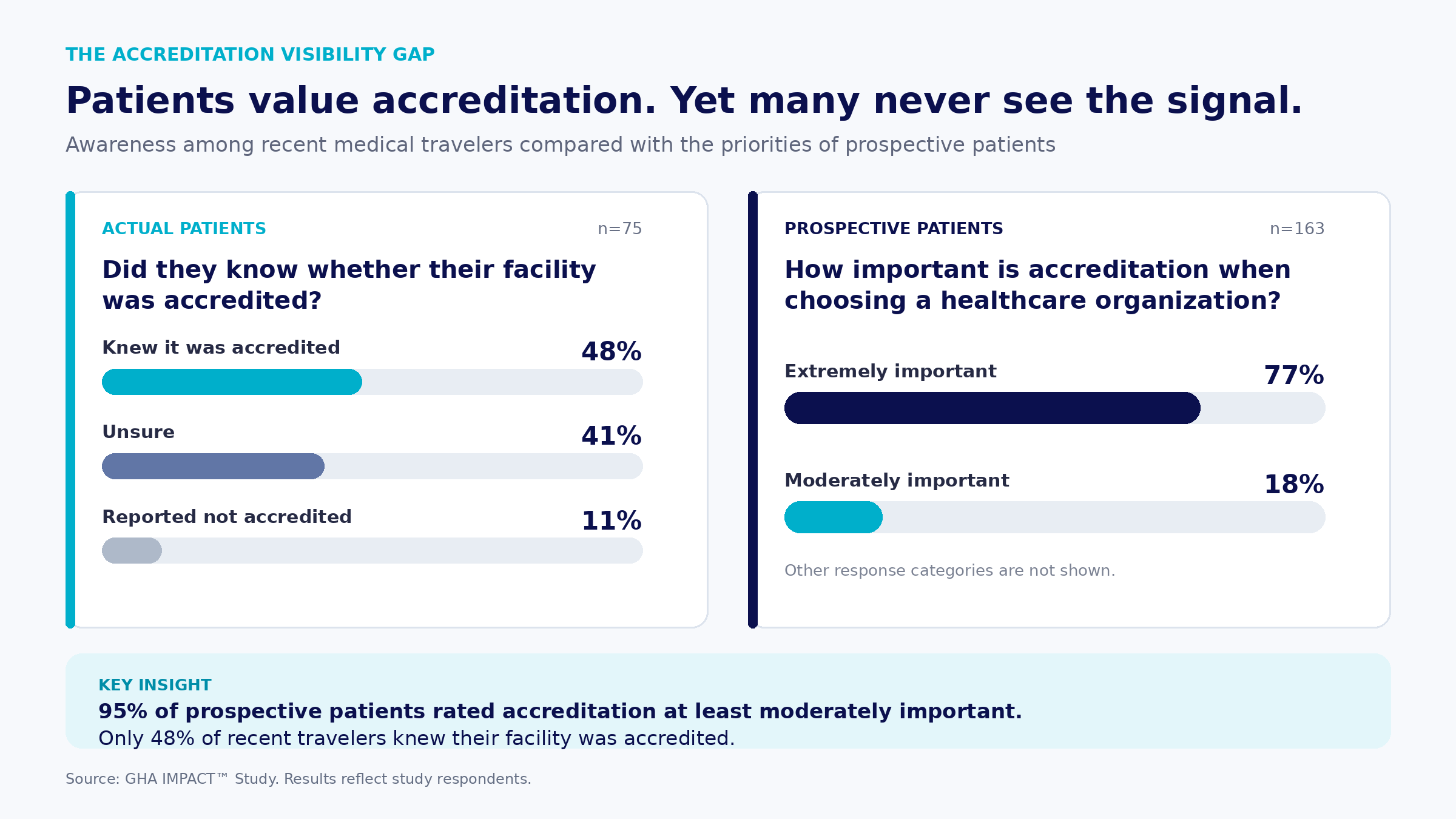
Among 75 respondents who had traveled internationally for medical care during the previous 24 months, only 48% knew that the facility where they received care was accredited. Another 41% were unsure, while 11% reported that it was not accredited. The contrast with prospective patients was striking: 77% considered accreditation extremely important when choosing a healthcare organization, and a further 18% considered it moderately important.
From Standards to Trust
The IMPACT™ Study examined perspectives from 238 patient respondents, including 75 recent patient travelers and 163 prospective patients, together with 231 healthcare leaders and buyers/referrers across more than 40 countries. Although the study focused on the international patient journey, its implications extend well beyond medical travel.
Patients everywhere are increasingly expected to make consequential choices in complex healthcare environments, often using digital information and with limited ability to assess clinical quality directly.
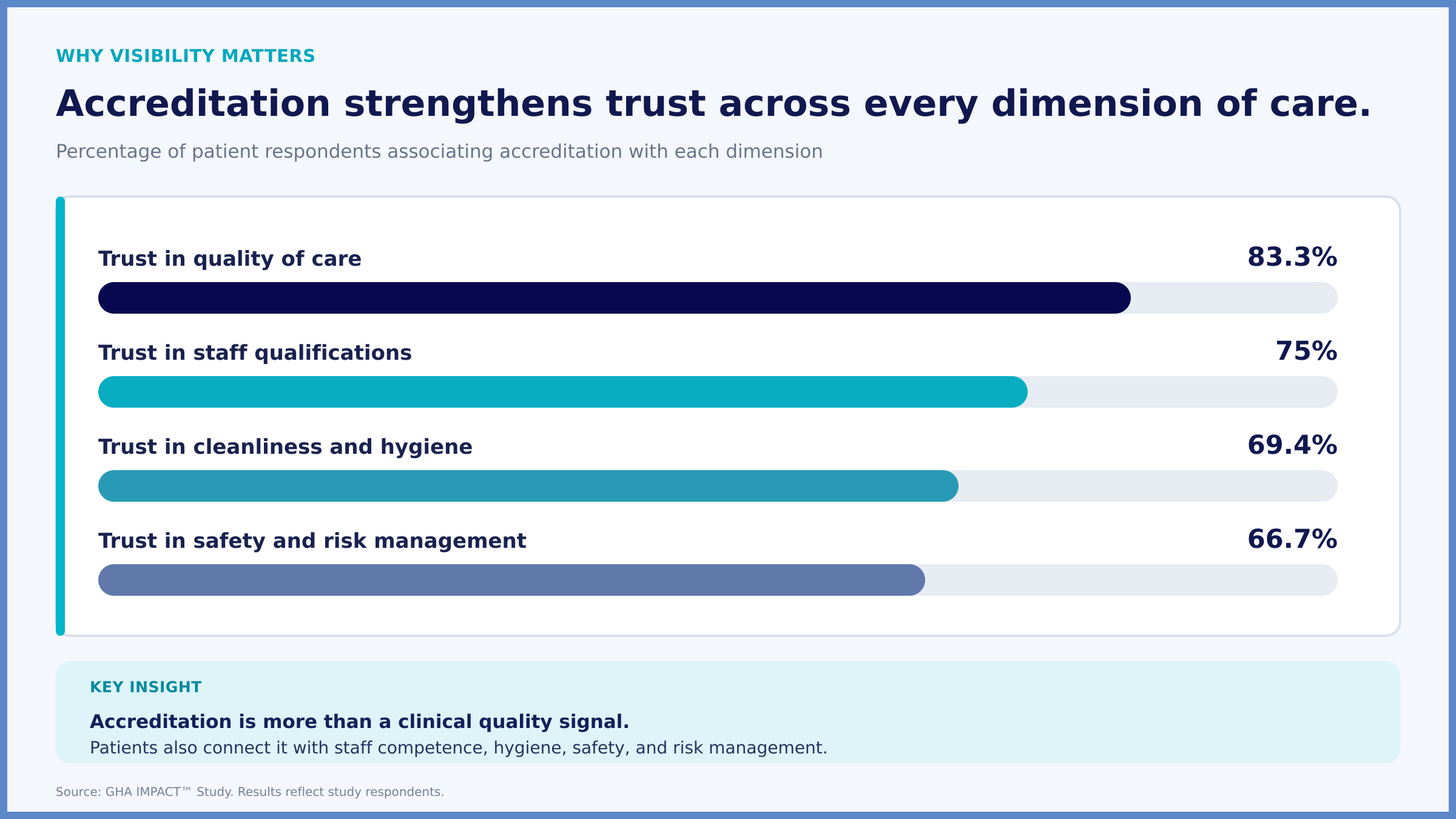
Accreditation helps address this information imbalance. It translates a complex set of organizational capabilities into an independent signal that defined standards have been assessed. Patient respondents associated accreditation with several dimensions of trust: 83.3% with confidence in quality of care, 75% with staff qualifications, 69.4% with cleanliness and hygiene, and 66.7% with safety and risk management. Patients reporting care at accredited facilities were also more likely to express confidence in safety standards and institutional reliability. These findings demonstrate association rather than causation, but the pattern is important: accreditation can help reduce uncertainty when patients understand what it represents. For accreditation bodies and accredited organizations alike, this raises a broader question: are we measuring only whether standards are met, or also whether patients can recognize and use the assurance those standards provide?
Missing at the Moment of Choice
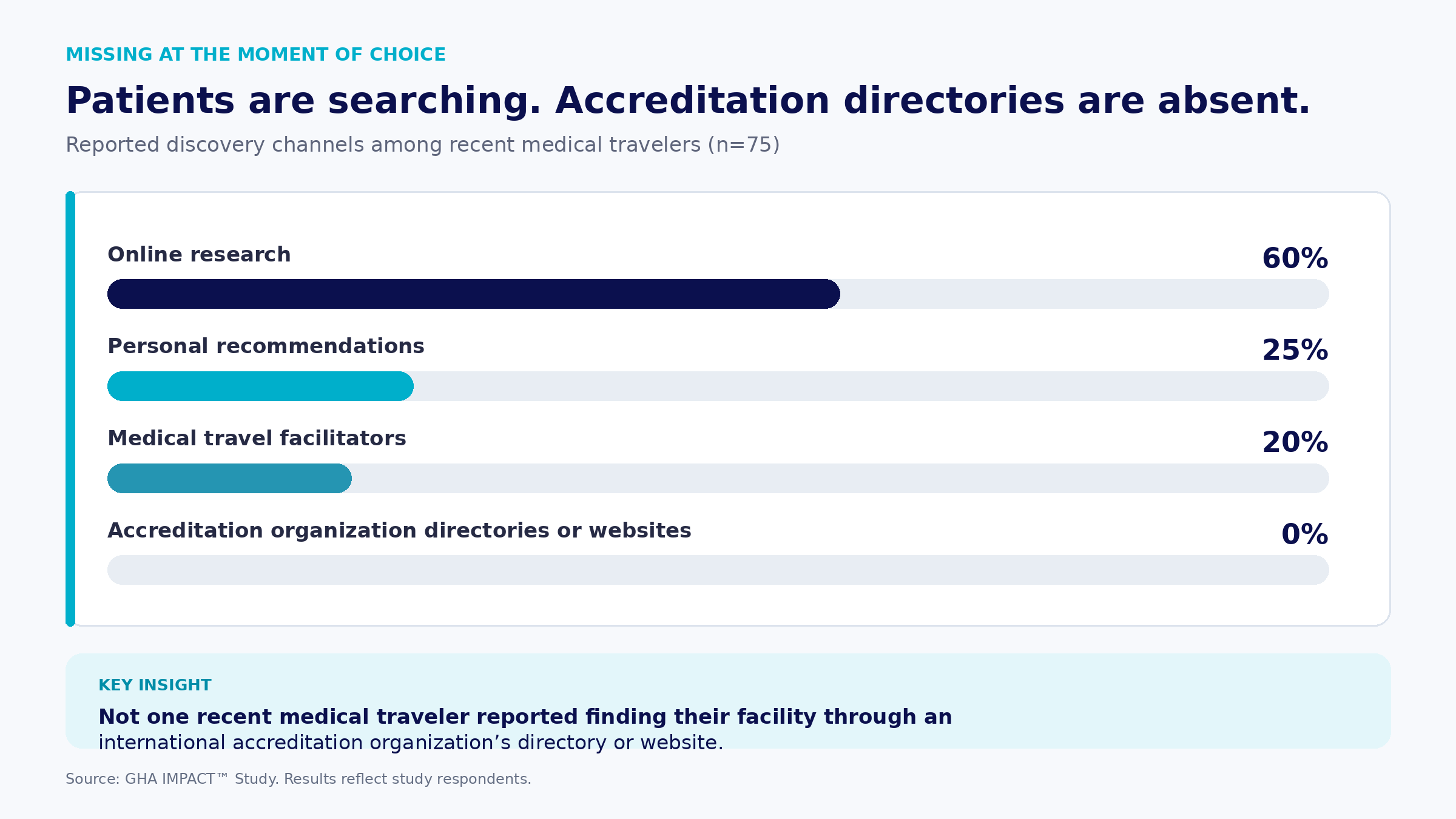
The difficulty is that a quality signal cannot influence a decision if it is absent, difficult to verify, or poorly explained. Not one of the 75 recent medical travelers in the study reported finding the facility through an international accreditation organization’s directory or website. Instead, the most commonly reported discovery channels included online research at 60%, personal recommendations at 25%, and medical travel facilitators at 20%. Accreditation was valued, but accreditation bodies themselves were largely missing from the point of discovery.
Closing the Last Mile
This should prompt reflection across the accreditation community. The last mile is not simply a marketing problem, nor should it be reduced to displaying a logo. It is a patient-information and trust problem. A seal without accessible meaning may create recognition, but not understanding. Conversely, a rigorous accreditation program that is almost invisible to patients leaves part of its public value unrealized.
Closing this gap requires three shifts.
Make accreditation findable. Directories should be searchable, current, accessible on mobile devices, and designed around patient questions rather than institutional terminology. Accredited organizations should also make their status easy to verify across websites, patient portals, appointment communications, and other decision points. Search visibility matters because patients may encounter accreditation long before they speak with a clinician or coordinator.
Make accreditation understandable. Patients need concise explanations of what was assessed and why it matters to their care. General claims of “quality” are less useful than clear language connecting accreditation to safety, communication, staff competence, care coordination, and continuous improvement. This is especially important across differences in language, culture, health literacy, and familiarity with healthcare systems.
Make it visible throughout the patient journey. Accreditation can be reinforced during inquiry, informed consent, care delivery, discharge, and follow-up, not simply as promotion, but as evidence of the systems supporting the patient. Organizations should also measure whether patients recognize accreditation, understand its relevance, and experience the practices it is intended to represent. Awareness, confidence, and patient-reported experience can therefore complement traditional compliance measures.
From Credential to Patient Confidence
The study’s cross-sectional design and purposive sampling mean that its findings should be interpreted as directional rather than globally representative. Even so, the visibility gap is sufficiently pronounced to merit attention. The issue is not whether accreditation has value. The issue is whether that value is reaching patients at the moment they need it.
Accreditation has long helped healthcare organizations demonstrate that they meet defined standards. Its next opportunity is to make that assurance more visible, understandable, and usable. Completing this last mile would not dilute the rigor of accreditation. It would extend its impact, turning a credential held by an organization into a trusted signal experienced by the people accreditation ultimately exists to serve.
For free access to the full IMPACT™ Study, go to: GHA Impact Study
.png)
GHA Standards Accredited by ISQUA
 Learn more